
As the Internet of Things (IoT) becomes deeply integrated into global operations, industries are experiencing unprecedented transformations. From smart cities and healthcare to agriculture, IoT is enabling real-time data access, automation, and decision-making. This blog analyzes the current market sizes and forecasted growth rates across major IoT verticals, helping identify which segments are maturing and which are poised for rapid expansion.
Market Size and Growth Comparison
The IoT market spans a diverse range of industries, each at different stages of adoption and growth. The IoT market landscape is defined by both widespread adoption in certain sectors and emerging momentum in others. One group of industries including IoT in Manufacturing, IoT in Healthcare, and Automotive IoT shows a combination of large market size and steady, reliable growth. These sectors have already integrated IoT into core operations, from smart manufacturing systems and connected medical devices to telematics and in-vehicle communication. Their scale reflects mature adoption, and although the growth is not the fastest, it is consistent and foundational to industrial digitization.
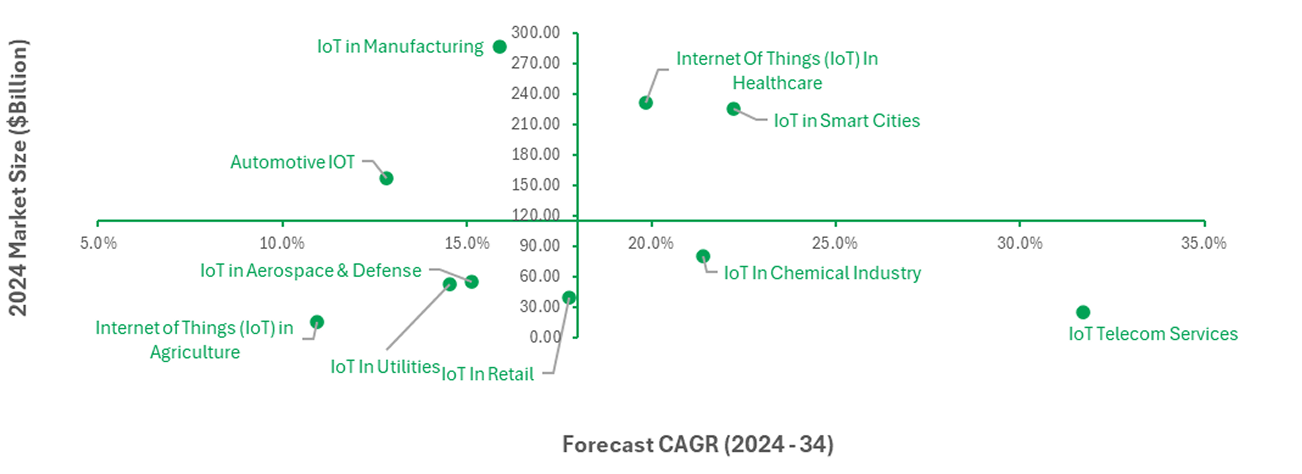
- IoT in Smart Cities stands apart as a large and fast-growing segment, driven by public and private investment in urban digitization. City authorities are increasingly implementing IoT for traffic management, smart lighting, pollution monitoring, and waste systems. This strong momentum reflects both the scale of opportunity and the prioritization of sustainable, data-driven infrastructure in urban planning.
- Another emerging cluster includes IoT in the Chemical Industry and IoT Telecom Services, which stand out for their high forecasted growth despite relatively smaller current market sizes. In the chemical industry, IoT is being deployed for real-time monitoring, predictive maintenance, and process automation—particularly valuable in hazardous environments where safety and efficiency are critical. Meanwhile, IoT Telecom Services are expanding rapidly as connectivity becomes the backbone of IoT infrastructure. Telecom providers are investing in 5G and low-·power wide area networks (LPWAN) to support the exponential rise in connected devices, enabling scalability across smart cities, industrial applications, and consumer IoT. While both segments are still scaling up in terms of value, their strong growth reflects accelerating demand for data-driven operations and connectivity layers.
- A broader set of markets including IoT in the Chemical Industry, Utilities, Aerospace & Defense, and Retail represents mid-scale segments with consistent growth. These sectors are steadily incorporating IoT for operational efficiency, safety, and customer engagement. For example, insurers are leveraging real-time data to personalize premiums, while retailers are using IoT to automate inventory and improve the shopper experience. Although individually these markets are not as large as manufacturing or healthcare, together they represent important areas of reliable expansion.
- Lastly, IoT in Agriculture continues to develop gradually. Despite its smaller size and slower growth, the sector holds significant promise particularly in enabling precision farming and optimizing resource use. Current adoption remains limited by infrastructure challenges and affordability issues, especially in fragmented and rural farming environments. However, over time, the potential for transformation remains strong.
Explore our comprehensive market reports in the IOT industry
Segment Insights

IoT in Manufacturing - Mature Market With High Adoption
As the largest segment with a market size of $286.53 billion, IoT in manufacturing reflects widespread use of connected devices for predictive maintenance, process optimization, and real-time monitoring. Smart factories increasingly rely on IoT-enabled automation to reduce downtime and enhance productivity. While growth is more moderate at 15.9%, the sector benefits from its deep integration into factory and supply chain operations.

Internet Of Things (IoT) in Healthcare - Expanding Role in Patient Monitoring and Diagnostics
Valued at $231.71 billion, the healthcare segment shows strong growth at 19.8%. Connected devices are transforming patient monitoring, diagnostics, and hospital operations. IoT helps enable remote care, chronic disease management, and hospital asset tracking, improving both patient outcomes and operational efficiency.

IoT in Smart Cities - Strong Market With Rapid Urban Adoption
Valued at $226.12 billion, this segment is growing at 22.2%, driven by urban investments in intelligent infrastructure. Applications include smart grids, intelligent traffic systems, pollution monitoring, public safety, and waste management. Governments and municipalities are adopting IoT to improve sustainability and quality of urban life.

IoT in Chemical Industry - Rising Adoption in Safety and Monitoring
This segment, valued at $80.38 billion and growing at 21.4%, is seeing increasing adoption of sensors and remote monitoring to improve plant safety, compliance, and performance. IoT helps detect equipment anomalies early, minimizing downtime and environmental risks.

Automotive IoT - Steady Growth With Strong Industry Focus
The automotive IOT market accounts for $157.10 billion, with a moderate growth rate of 12.8%. IoT enables features such as telematics, connected diagnostics, real-time vehicle tracking, in-vehicle infotainment, and autonomous navigation—paving the way for connected mobility solutions.

IoT in Aerospace & Defense - Operational Efficiency in Critical Environments
Valued at $55.42 billion, this sector is growing steadily at 15.1%. IoT is used for equipment health monitoring, predictive maintenance, mission planning, and logistics in high-risk or high-precision environments.

IoT in Utilities - Enabling Smart Grid and Remote Control
At $52.31 billion, this segment grows at 14.5%, supporting grid digitization, smart metering, and remote asset monitoring. Utilities are leveraging IoT to optimize energy usage, detect outages in real time, and improve sustainability targets.

IoT in Retail - Enhancing Customer Experience and Operations
At $39.52 billion, this segment is growing at 17.8%. Retailers use IoT for inventory management, shelf monitoring, personalized promotions, and in-store analytics. It plays a growing role in omnichannel strategies and consumer engagement.

IoT Telecom Services - Rapid Growth From Network Demand
While the current market size is relatively smaller at $25.33 billion, the growth rate is impressive at 31.7%. Telecom operators are investing in infrastructure like 5G and narrowband IoT to support rising device connectivity. The sector is key to supporting the backbone of all IoT deployments.

Internet of Things (IoT) in Agriculture - Precision Farming in Early-Stage Expansion
At $14.87 billion, this is one of the smaller IoT markets but essential for digital transformation in farming. With a 10.9% growth rate, IoT is being applied to smart irrigation, crop health monitoring, livestock tracking, and yield forecasting, particularly in large-scale farming operations.
The IoT landscape reveals a mix of mature giants and emerging disruptors. While manufacturing, healthcare, and smart cities dominate in scale, sectors like telecom services are racing ahead in growth. Meanwhile, agriculture and traditional utilities remain essential but slower adopters. As edge computing, AI, and 5G expand, IoT will continue reshaping how industries operate connecting people, devices, and infrastructure in smarter, more efficient ways.
Turn market trends into confident decisions
Request a demonstration to explore detailed market sizing, forecasts and supporting analysis in GMM.